A short history of Glamorous Toolkit
Glamorous Toolkit embodies our long-term goal of making the inside of software systems explainable. It is the first environment that supports Moldable Development.
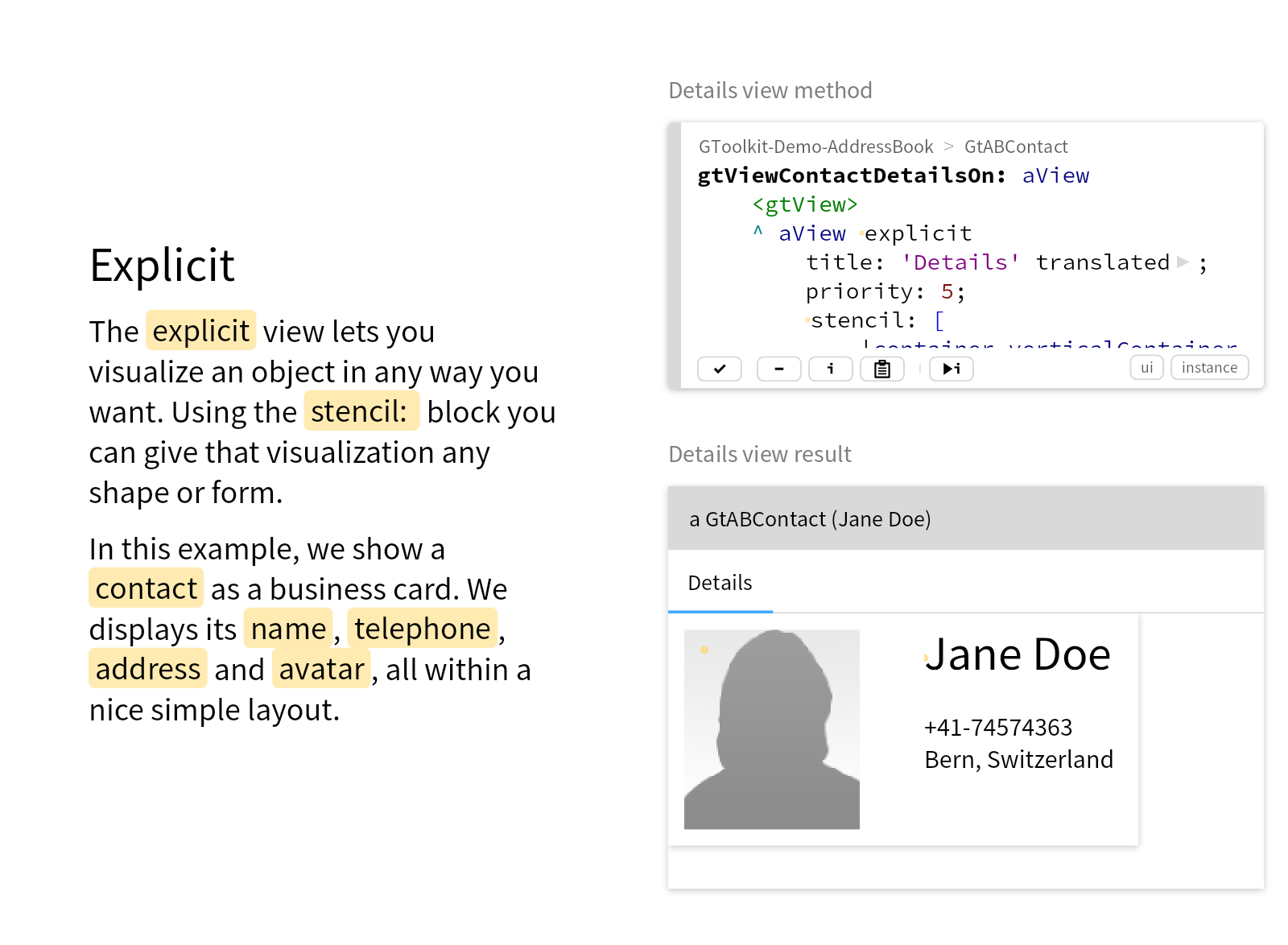
The first version of a Moldable Inspector was implemented in 2011, and supported extensible ways to present and inspect objects. It is documented in several papers:
- The Moldable Inspector: a framework for domain-specific object inspection, IWST 2014 - GTInspector: A Moldable Domain-Aware Object Inspector, Software for Humanity, SPLASH 2015 - The Moldable Inspector, Onward! 2015
The Moldable Debugger followed in 2013. It offered a tailorable way to debug applications that use diverse programming styles, such as announcements or parsing rules. See:
- Towards a Moldable Debugger, DYLA 2013 - The Moldable Debugger: A Framework for Developing Domain-Specific Debuggers, SLE 2014 - Practical domain-specific debuggers using the Moldable Debugger framework, Computer Languages, Systems & Structures, 2015
The first GT Spotter was implemented in 2014, offering a unified way to express and combine search tools. See:
- Spotter: towards a unified search interface in IDEs, Software for Humanity, SPLASH 2015 - Moldable, context-aware searching with Spotter, Onward! 2016
Andrei Chiş defended his dissertation on Moldable Tools at the University of Bern in September 2016. The thesis showed how integrated development tools, instead of being implemented in a fully generic way, could be adapted dynamically to the context of specific application domains, offering developers tailored ways to reason about applications under development.
feenk was founded in October 2015. Development of a new Glamorous Toolkit platform began in August 2017 and was first demoed at ESUG 2018. The first Glamorous Toolkit v0.7.1214 beta was released in July 2020, and Glamorous Toolkit v1.0 was released in August 2023.
The first large scale case study of Moldable Development using Glamorous Toolkit was made public in May 2025.